Association Master: Word Game
- 4.5
- Rating
- 1.00M
- Installs
- Free
- Price
 Analysis by App-foxy
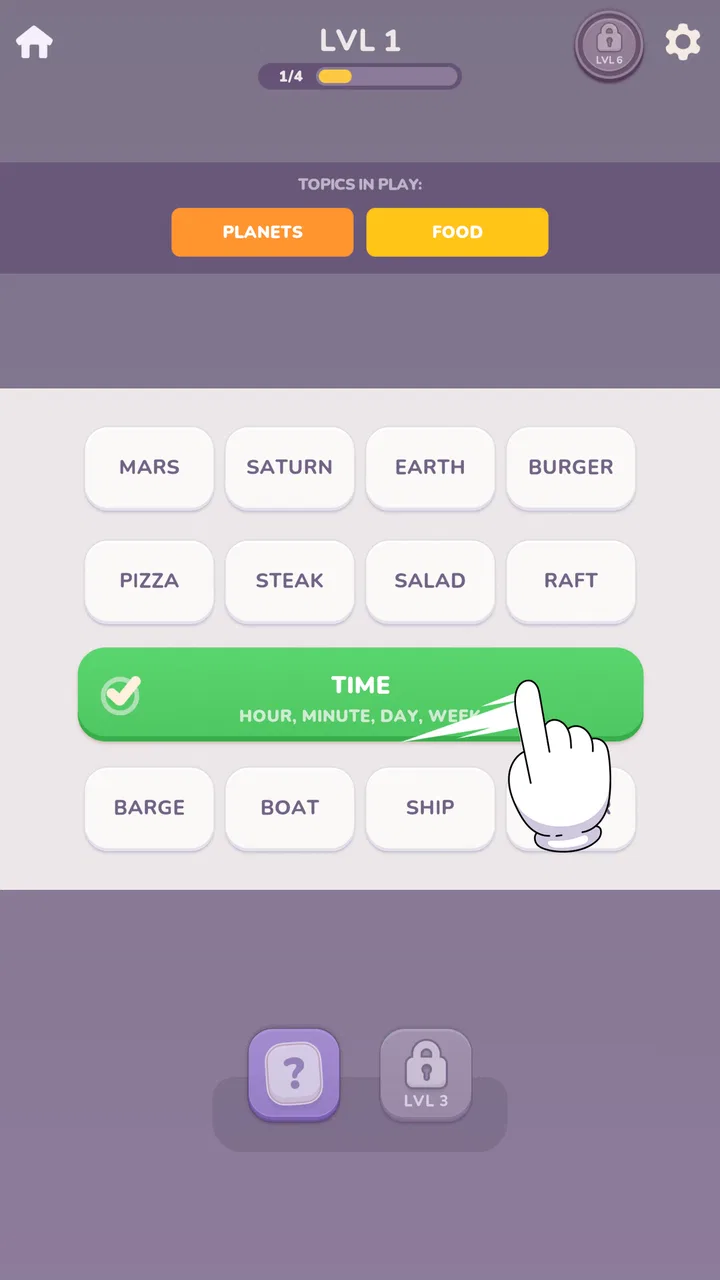
I found Association Master to be a pleasantly focused word game: simple to understand, but just demanding enough to make me pause before committing to an answer. The central idea is to connect words that belong together, so each puzzle asks me to think about meaning rather than spelling speed or general knowledge alone. It is the kind of game I can open for a short break, yet it also rewards a more deliberate approach when a group of words seems to have several possible relationships.
That balance is the main reason I would recommend it to people who enjoy compact vocabulary challenges. It does not try to become a full dictionary, a crossword collection, or a competitive quiz show. Instead, it concentrates on association, which gives the game a distinct rhythm. I look for a connection, test whether it feels consistent with the other words, and then adjust my interpretation when the obvious answer turns out to be too narrow.
How the everyday puzzle flow feels
My usual session starts with a quick scan rather than an immediate answer. I read every visible word, identify the ones that seem strongly related, and leave the uncertain terms alone for a moment. That small habit matters because the first connection I notice is not always the intended one. A word can fit several themes, while the surrounding choices usually reveal which meaning the puzzle expects.
You May Also Like

 Blood Strike: 2.5 Anniversary
Blood Strike’s Loadouts Turn Every Drop Into a Tactical Gamble
A close look at Blood Strike’s custom loadouts: how fast access to signature weapons reshapes its battle royale rhythm, rewards preparation, and narrows the gap between fights.

 Pandora - Music & Podcasts
Pandora’s Music Is Easy to Start, but Harder to Recover
Pandora’s strength is its low-effort path from a seed to a station. Its weak spot is how much confidence it asks you to place in connection, setup, and quiet recovery.

 8 Ball Pool
 Is Built on Rivalries, Rematches, and Routine
A close look at the rivalries, rematches, shared routines, and unanswered safety questions that turn a quick pool match into a persistent mobile community.

 Samsung Music
’s Quiet Strength Is Playing What You Already Own
Its reach comes less from spectacle than from dependable access to a personal library. That simplicity is both the app’s strongest retention engine and its ceiling.

 AccuWeather: Weather Radar
AccuWeather Review: A Quick, Clear Forecast for Everyday Decisions
For everyday plans, the best forecast is the one you can understand quickly. AccuWeather makes rain timing, radar, and local conditions easy to act on, with a few trade-offs.

 Hill Climb Racing
Why Hill Climb Racing Still Turns Crashes Into One More Run
A tiny car, a bumpy hill and one more upgrade: Hill Climb Racing keeps resurfacing because its simple chaos makes every near-miss feel personal.
More From Our News Desk



The basic workflow is easy to pick up. I select words that make sense together, check the result, and continue with the remaining possibilities. Because the game is built around relationships between words, the most useful skill is not memorizing obscure facts. It is learning to switch between broad and specific meanings. A word associated with food, for example, might point toward an ingredient, a meal, a kitchen object, or an action. I get better results when I ask what level of meaning the group is using.
This makes the game suitable for short sessions during an ordinary day. I can play while waiting for an appointment, during a quiet coffee break, or when I want something more active than scrolling. A realistic routine is to solve a few puzzles in the morning, stop before the experience becomes tiring, and return later with a fresh view of any difficult group. The pause is useful because association puzzles often become easier when I stop staring at the same arrangement.
The presentation is approachable enough for casual players, and the Everyone content rating makes it a reasonable choice for a broad audience. I would still judge it by the player rather than the label alone: younger users may enjoy the word connections, while adults who like language games may appreciate the ambiguity. It is not dependent on reflexes, so it can also suit anyone who prefers thoughtful play over rapid tapping.
One of the game’s quiet strengths is that it encourages me to explain my reasoning. When I think, “these words belong together because they are all related to travel,” I am using a different mental process from simply recognizing a matching pair. That makes a correct solution feel earned. It also makes a wrong choice informative, since I can see that my category was too broad, too literal, or based on only one word.
What I check before settling on a group
I try to find at least two strong links before treating a group as reliable. If one word fits perfectly but the others only fit through loose associations, I keep looking. This prevents a common mistake: building a category around the most noticeable word and forcing everything else into it. The game becomes much smoother once I distinguish a genuine pattern from a collection of vaguely related ideas.
I also pay attention to word form. Sometimes a connection may depend on how a word is commonly used rather than on a strict dictionary definition. That means I do not reject a possible group merely because the words are not identical in grammatical form. At the same time, I avoid accepting a group just because I can invent an unusual interpretation. The intended relationship usually feels natural when viewed as a complete set.
When I reach a final pair or group, I reconsider the earlier choices instead of treating the remaining words as leftovers. A difficult remainder often exposes the error in an earlier selection. This reverse check is especially helpful in a game where several words can appear compatible at first glance. It turns the puzzle into a process of elimination without making it feel like a dry logic exercise.
Settings and small habits that improve the experience
I recommend checking the available settings before settling into a long session. I do not change options automatically; I first look for controls that affect comfort, sound, notifications, or the way the game behaves on my device. The practical point is not to hunt for a secret mode, but to make the basic puzzle loop less distracting. If I am playing in a quiet place, I prefer a restrained setup. If I am using the game as a more active break, I may leave feedback sounds enabled.
It is also worth checking whether the game’s current behavior suits the way you plan to play. A person who wants a calm, low-pressure word exercise may prefer fewer interruptions, while someone who likes immediate feedback may find the normal presentation more satisfying. I treat these choices as part of the workflow rather than as decoration. A comfortable setup makes it easier to concentrate on the word relationships instead of the phone itself.
The developer is SayGames Ltd, and the current version is 1.2.2. That is useful context for anyone comparing the game with older impressions or deciding whether to update before playing. I would keep the app current through the normal store process, particularly if the game behaves differently after an update. Version details are not a reason to overthink the download, but they can explain why two players describe small parts of the experience differently.
Another useful habit is to play with a consistent stopping point. I stop after a difficult puzzle if I notice myself tapping based on hope rather than evidence. That keeps the game from turning into random guessing. For players who want to improve, a short reflection after a mistake is more valuable than immediately rushing into another round: was the category too broad, did I overlook a secondary meaning, or did I commit before checking the remaining words?
Patterns that make difficult associations clearer
Experienced play is less about being naturally good with words and more about using repeatable checks. My first check is semantic distance. I look for a group whose members share a clear relationship, not merely a common mood or topic. My second check is exclusivity: if the same word fits several possible groups, I ask which arrangement leaves the cleanest solution for everything else.
A third check is the level of the category. Some groups are concrete, such as objects or actions, while others may depend on a broader concept. Mixing those levels too early can create confusion. I therefore test concrete interpretations first, then move toward abstract ones when the remaining words demand it. This approach reduces the temptation to use an elaborate explanation when a simpler one is available.
I also use the “leftover test.” After I imagine a group, I mentally remove it and examine what remains. If the rest suddenly forms a stronger, more coherent pattern, the original choice is probably sound. If the remaining words become a pile of unrelated terms, I reconsider. This is one of the most effective habits I have developed because it evaluates the whole puzzle instead of rewarding the first attractive connection.
Another practical technique is to separate certainty from possibility. I treat a word as confirmed only when it supports the group and does not create a serious problem elsewhere. Everything else stays provisional. This sounds cautious, but it actually makes me faster because I spend less time undoing rushed choices. It is particularly helpful when a familiar word has a common meaning that distracts from a less obvious but more consistent one.
For a shared play session, I would let each person describe a proposed connection before selecting it. That turns the game into a small discussion about language and interpretation. It can work well with family members or friends because two people may notice different senses of the same word. The only drawback is that the conversation can make a short puzzle take longer, so it is better for players who enjoy reasoning aloud rather than those seeking a private, rapid session.
Where the game’s simplicity becomes a limitation
The focused design is also the main limitation. Players looking for a large variety of modes, a deep progression system, or a competitive multiplayer structure may find the experience too narrow. Its appeal depends on enjoying the central association mechanic. If that kind of puzzle does not hold your attention, there is not much else here to compensate for it.
I would also avoid treating every answer as a test of pure vocabulary knowledge. Some puzzles may feel difficult because a word has several reasonable interpretations, not because the player lacks intelligence or language ability. That ambiguity can be satisfying when the final group clicks, but it can also feel frustrating if I believe my alternative connection is equally natural. The fairest way to approach those moments is to judge the full arrangement rather than one isolated pair.
The free price makes it easy to try, although in-app purchases range from $1.99 to $15.99 per item. I would not spend immediately. I would first decide whether the core loop remains enjoyable after repeated sessions and whether any optional purchase genuinely improves my personal routine. For a casual player, the free experience may be enough. Someone who plays regularly should consider the cost carefully instead of assuming that a word game needs an upgrade to be worthwhile.
The game has an average rating of 4.5 from around 9.4 thousand ratings, with more than 500 written reviews, and it has passed one million installs. Those figures suggest that the concept has found a substantial audience, but they do not replace personal fit. A popular word puzzle can still be the wrong choice for someone who prefers crosswords, anagrams, or trivia. I see the audience response as encouragement to try it, not as proof that every player will enjoy its particular style.
Device compatibility is straightforward for many users because it supports Android 8.0 and later. Before installing on an older phone or tablet, I would check the operating system rather than assume that every Android device is covered. For supported devices, the more important question is whether the player wants a calm association game or a richer word-game package. That distinction matters more than technical compatibility once the app runs properly.
Who will enjoy it, and who should choose something else
I think Association Master is best for players who like making connections, testing interpretations, and solving at their own pace. It is a good fit for a commuter who wants a compact mental exercise, a language learner who enjoys seeing how words relate, or a family looking for a game that can prompt conversation. It also suits people who tire quickly of reaction-based games but still want a reason to pick up their phone.
I would be more cautious recommending it to someone who wants a structured lesson plan. Although the puzzles exercise attention and vocabulary, I would not use it as a replacement for a language course or a systematic vocabulary tool. It gives me practice in flexible thinking, but it does not organize that practice around grammar, pronunciation, or a planned list of new words.
Compared with a crossword, this game asks for broader conceptual linking rather than intersecting clues and letter placement. Compared with an anagram game, it relies less on rearranging letters and more on recognizing meaning. Compared with trivia, it does not primarily reward stored facts. I prefer it when I want a middle ground: enough structure to feel like a puzzle, but enough openness to make interpretation part of the challenge.
Players who need constant novelty may eventually prefer a broader word-game collection. A dedicated crossword app can offer more clue styles, while a spelling game may provide a clearer sense of measurable progress. I would choose this title instead when I value short, self-contained association problems and do not need a large set of unrelated mechanics around them.
My verdict after building a repeatable routine
After using the game with a simple routine—scan first, hold uncertain words back, test the whole group, and review mistakes—I found it more rewarding than the store summary initially suggests. The concept is easy to describe, but the best moments come from noticing how a familiar word can change role depending on its neighbors. That is where the game earns its place as a thinking exercise rather than just a sequence of taps.
My strongest recommendation is to resist guessing too early. The game rewards patience, and a few seconds spent comparing alternative meanings can save several failed attempts. I would also use the settings to remove avoidable distractions, play in short sessions, and decide about purchases only after establishing a regular habit. Those choices do more to improve the experience than trying to rush through puzzles.
The key trade-off is focus versus variety. Association Master does one thing clearly: it asks me to connect words through sensible relationships. That focus gives the puzzles a clean identity, but it also means the game may feel limited to players who expect multiple modes or a deep long-term system. For me, the narrow scope is acceptable because the core mechanic is approachable and has enough ambiguity to stay interesting.
Released on February 27, 2025, and offered as a free word game for everyone, it is easy to recommend as a low-commitment trial. I would install it for short mental breaks, casual group discussion, or a quieter alternative to reflex games. I would skip it only if I wanted extensive crossword features, formal vocabulary study, or constant competitive variety. For the right player, it is a thoughtful little puzzle that becomes noticeably better once you stop chasing the first connection and start examining the complete pattern.
FAQs for Association Master: Word Game
01What is Association Master: Word Game?
Association Master: Word Game is a vocabulary and word-association puzzle designed around finding connections between related words. Instead of simply guessing random answers, you need to identify the common idea, category, or relationship linking the clues shown on screen. Its straightforward format makes it easy to start, while progressively more challenging puzzles test concentration, vocabulary, and lateral thinking.
02How do you play Association Master: Word Game?
Each puzzle presents a group of words or clues that are connected in some way. Your task is to work out the association and enter or select the answer that best completes the relationship. Some levels are immediately obvious, while others require you to consider synonyms, categories, meanings, or less direct connections. Carefully reviewing every clue is usually more effective than focusing on only one word.
03Is Association Master: Word Game suitable for beginners?
Yes, the game is generally accessible to beginners because its basic mechanic is simple to understand and does not require complicated controls. Early puzzles can help players learn how associations are structured before the difficulty increases. However, later challenges may demand a broader vocabulary and more creative reasoning, so the experience can also appeal to experienced word-game fans looking for a mental workout.
04Can I play Association Master: Word Game offline?
Offline availability may depend on the version of the app, your device, and whether certain features require an internet connection. Core puzzle gameplay may be accessible without constant connectivity, but advertisements, synchronization, updates, leaderboards, or other online services can require internet access. If offline play is important to you, it is worth checking the current store description and testing the game after installation.
05Does Association Master: Word Game include hints or in-app purchases?
Many word-puzzle games of this type provide hints, assistance, or optional rewards when a player gets stuck, and some versions may offer in-app purchases or advertising connected to those features. The exact options can vary after updates and between Android and iOS releases. Before downloading, review the store listing and the app’s purchase settings, especially if the game will be used by children.
Pros
- Relaxing word puzzles suitable for short or extended play sessions.
- Helpful hints make difficult association challenges less frustrating.
- Simple interface is easy to understand from the first puzzle.
- Progression encourages regular play without requiring fast reactions.
- Good choice for players who enjoy vocabulary and lateral thinking.
Cons
- Some answers may feel subjective or open to multiple interpretations.
- Puzzle difficulty can vary noticeably between consecutive levels.
- Repeated hint use may reduce the satisfaction of solving puzzles.
- Players seeking action or competitive multiplayer may find it slow.
- Later puzzles may require advanced vocabulary or cultural knowledge.

Association Master: Word Game
Gallery